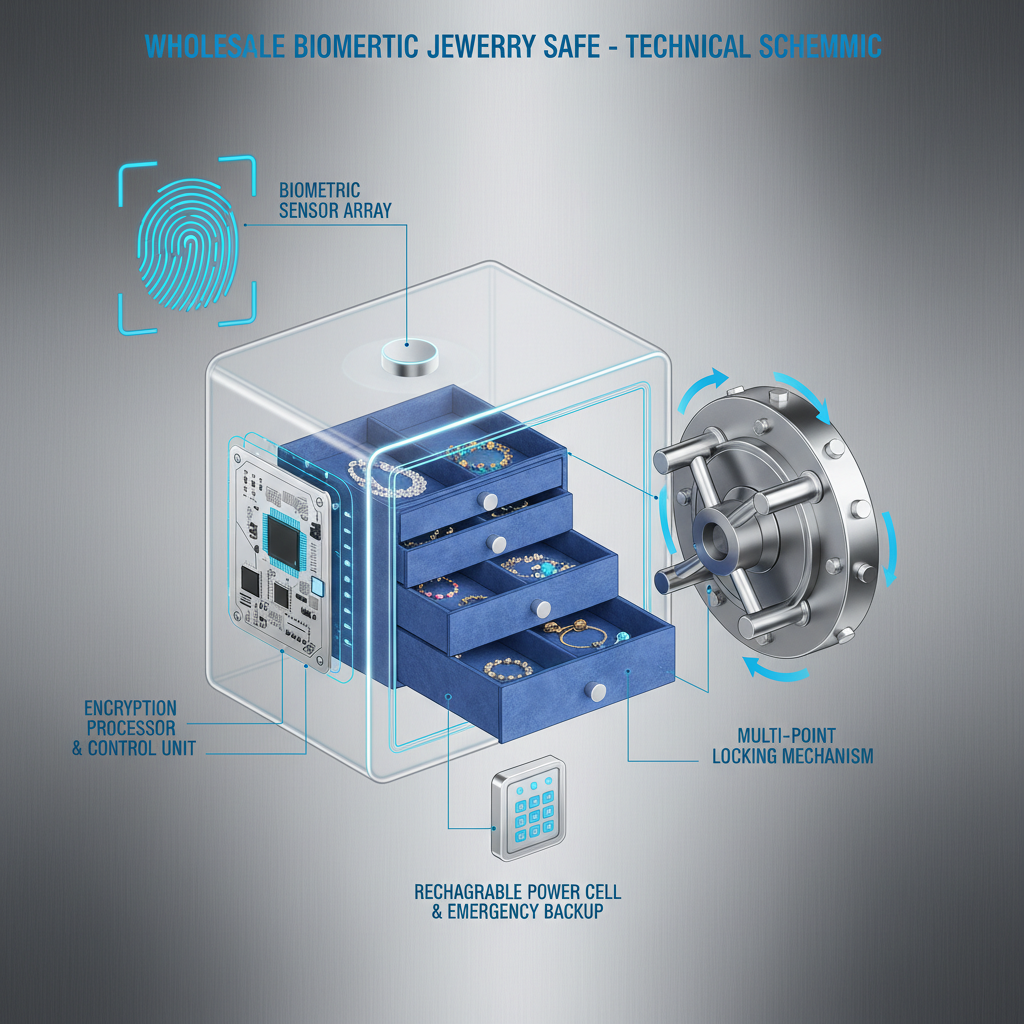


For commercial buyers and security distributors, sourcing a Wholesale small cash safe requires a balance between high-volume cost efficiency and uncompromising security standards. These compact storage units are essential for businesses ranging from hospitality and healthcare to retail and financial services, where the secure management of petty cash, sensitive documents, and small valuables is a daily operational requirement.
The complexity of bulk procurement lies in ensuring that every unit maintains structural consistency and locking reliability. In the B2B sector, a security failure in a single unit can compromise a client's trust. Therefore, understanding the manufacturing process—from the shearing of reinforced steel to the digitalized assembly lines—is critical for evaluating a supplier's ability to deliver consistent, high-grade security equipment at scale.
This guide provides a technical and commercial analysis of compact security boxes, focusing on the selection criteria that professional buyers should prioritize. We will explore material specifications, locking technologies, and the operational advantages of partnering with high-tech manufacturers who integrate CNC production and automated spraying to ensure product longevity and breach resistance.
B2B Procurement of Compact Security Storage
The procurement of bulk security storage is not merely a transaction of goods but a risk management decision. For a professional Wholesale small cash safe distributor, the primary objective is to secure a supply chain that minimizes defects and maximizes durability. This involves analyzing the manufacturer's industrial capacity; for instance, facilities that cover extensive areas like 16,867 square meters and utilize welding robots can typically offer better price-to-performance ratios due to economies of scale.
From a technical standpoint, the "small" designation in these safes refers to their compact footprint, but the security must remain "large." This is achieved through the use of precision-engineered door structures and reinforced steel bodies. Buyers must look for manufacturers who utilize digital intelligent production equipment, as this reduces human error in the stamping and welding phases, ensuring that the gap between the door and the frame is minimal, thereby increasing resistance to prying tools. Furthermore, the integration of high-quality raw material controls ensures that the steel used is resistant to drilling and forced entry, meeting the rigorous demands of commercial environments.
Strategic Evaluation for Bulk Safe Acquisition
When evaluating security solutions for wholesale distribution, buyers should move beyond basic dimensions and focus on the engineering logic that governs the product's resilience and usability across different industry sectors.
Steel Grade and Material Integrity
The primary defense of any security box is its material composition. Professional-grade units employ reinforced steel that has been treated for maximum hardness. The consistency of the steel thickness across the walls and the door is a key indicator of quality. Manufacturers using CNC production equipment ensure that each component is cut to exact tolerances, which is vital for the structural integrity of the vault.
| Material Aspect | Industry Standard | Risk of Low Quality | Buyer Verification |
|---|---|---|---|
| Body Steel | Reinforced Cold-Rolled Steel | Structural warping / Easy drilling | Check wall thickness specifications |
| Door Design | Precision-engineered fit | Pry-bar entry points | Inspect gap tolerances |
| Coating | Automated powder spraying | Rapid corrosion / Peeling | Verify spray line automation |
| Hinges | Reinforced internal/external | Easy removal of door | Test hinge load capacity |
| Weight | Proportional to size (e.g., 60-350kg) | Lack of stability / Easy theft | Cross-reference weight with dimensions |
| Assembly | Robot-welded seams | Weak points at joints | Inspect weld bead consistency |
Locking Mechanism Diversification
A wholesale security solution must offer various locking options to suit different end-user needs. Mechanical locks provide reliability without power requirements, while electronic password systems offer convenience and audit trails. High-security models often utilize dual-lock combinations. For bulk buyers, the reliability of the electronic components is paramount; encrypted password inputs and tamper alarms are essential features that prevent unauthorized access and alert owners to attempted breaches.
Internal Spatial Optimization
Value is created through the efficient use of internal volume. The Shengling Series, for example, maximizes capacity while maintaining a compact external footprint. For B2B clients, modular interiors—such as adjustable shelves and specialized compartments—allow the safe to be repurposed for different items, whether it be stacks of currency, legal documents, or digital media. This flexibility increases the marketability of the product for the wholesaler.
Fire Resistance and Thermal Protection
Beyond theft protection, the risk of fire is a critical concern for document and cash storage. The integration of specialized fire-resistant materials in the walls and doors safeguards contents from high temperatures during emergencies. When sourcing in bulk, buyers should verify the duration of fire protection and the materials used to ensure they meet the regulatory standards of the target market, such as the hospitality or medical sectors.
Customization and Portable Options
Market demand often requires custom portable solutions that do not sacrifice security. Customization can range from interior lining materials to specific external dimensions. A manufacturer's ability to offer these variations—supported by a professional design team—allows wholesalers to capture niche markets, such as traveling professionals or temporary office setups, who require security that can be relocated.
Industrial Production Scale and Consistency
Production capacity is a proxy for reliability. A facility capable of an annual output of 200,000 pieces suggests a mature manufacturing process. The transition from manual labor to digitalized production—incorporating one-time mold forming lines and automated spraying—ensures that the 1st unit and the 10,000th unit are identical in quality. This consistency is the most important factor for B2B buyers managing large-scale deployments.
Application-Specific Deployment
Different environments dictate different security requirements. Residential users prioritize aesthetics and basic theft prevention, whereas hotels require rapid code changes for guests. Financial institutions and government offices demand higher weight and reinforced anti-pry edges. By offering a range of models—from the 50kg compact units to the 450kg double-door heavy-duty versions—a supplier can provide a comprehensive security ecosystem for any commercial application.
FAQ
What are the primary factors to consider when buying bulk security boxes?
Buyers should prioritize three main factors: material grade (reinforced steel thickness), locking technology (reliability of electronic vs mechanical systems), and manufacturing consistency. It is also crucial to evaluate the supplier's production capacity and their use of automated equipment like CNC machines and welding robots to ensure that every unit meets the same quality benchmark, reducing the rate of defective returns.
How does automated production affect the quality of compact safes?
Automated production significantly increases precision. Digitalized shearing and stamping ensure that the door and frame fit perfectly, leaving no gaps for pry bars to enter. Automated spraying provides a uniform, durable coating that prevents rust and wear. Robot welding creates stronger, more consistent seams compared to manual welding, which is essential for maintaining the structural integrity of the safe under forced entry attempts.
Can these safes be customized for specific business needs?
Yes, professional manufacturers often provide customization options including adjustable interior shelving, specific compartment layouts, and customized portable designs. This is particularly useful for industries like hospitality or specialized medical storage where the items being secured vary in size and shape. Customization allows wholesalers to offer tailored solutions to their clients, increasing the value proposition of the security equipment.
What is the difference between a standard home safe and a commercial-grade bulk unit?
Commercial-grade units are typically built with higher-density reinforced steel and more robust locking mechanisms designed for frequent use. While a home safe might focus on basic deterrence, commercial units often feature multi-point locking systems, anti-pry edges, and higher fire-resistance ratings. Additionally, commercial bulk units are produced using industrial-scale automation to ensure absolute uniformity across thousands of pieces.
How should a buyer evaluate a manufacturer's security credentials?
A buyer should examine the manufacturer's facility size, registered capital, and the specific technology they employ. A high-tech enterprise integrating R&D with digital production (like CNC and automated lines) is more likely to meet international security standards. Checking for certifications, the ability to provide detailed technical specifications for every model, and a proven annual output capacity are also strong indicators of a reliable B2B partner.
What are the typical applications for the different size models?
Small units (e.g., 50-70kg) are ideal for in-room hotel safes or personal office use. Mid-sized units (90-175kg) are typically used for petty cash management and confidential file storage in small businesses. Heavy-duty models (230-450kg), often with double doors, are suited for centralized storage in financial institutions, government offices, or large corporate archives where higher volume and maximum security are required.
References and further reading
- Global Security Standards for Steel Storage Units - Industry Technical Guide
- Principles of CNC Precision Manufacturing in Security Equipment
- Comparative Analysis of Electronic vs Mechanical Locking Systems in B2B Safes
Related Articles